Human Trafficking and Slavery in the Muslim World: Islamic Law and Human Rights Advocacy as Key Factors in Eradicating this Millenary Practice
DOI:
https://doi.org/10.58524/jiccr.v1i2.34Keywords:
slavery, human trafficking, Islamic law, emancipation, exploitation, Muslim world, legal reformAbstract
This study examines the historical evolution and contemporary manifestations of slavery and human trafficking in the Muslim world by integrating historical analysis, Islamic legal interpretation, and modern human rights perspectives. The research addresses the central problem of the persistence of exploitative practices such as forced labor, child exploitation, and coercive religious or educational systems despite the ethical and legal principles within Islam that emphasize human dignity and freedom. Using a qualitative documentary method, the study analyzes pre-Islamic practices, early Islamic reforms, classical legal traditions, and current forms of exploitation in Muslim-majority societies. Findings reveal that slavery in pre-Islamic Arabia was deeply embedded within regional social structures, but Islam introduced significant moral and legal reforms that promoted humane treatment and encouraged emancipation. However, variations in cultural and political contexts across regions allowed certain practices to persist. In the modern era, new forms of human trafficking continue to challenge both legal frameworks and societal norms. The study concludes that Islamic teachings, when understood through their historical and ethical trajectory, provide a strong foundation for eliminating all forms of human exploitation. It also highlights the importance of contemporary legal interpretations that reject slavery entirely and call for greater alignment between Islamic principles and modern human rights standards.
Downloads
References
“9 Being a master.” [Internet]. Available from: https://sunnah.com/adab:181 [Accessed: 2024-07-07].
“9 Being a master.” [Internet]. Available from: https://sunnah.com/adab:192 [Accessed: 2024-07-07].
“45 The Book of Oaths (qasamah) Retaliation and Blood Money.” Sunan an-Nasa'i 4736, [Internet]. Available from: https://sunnah.com/nasai:4736 [Accessed: 2024-07-07].
“49 Manumission of Slaves.” [Internet]. Available from: https://sunnah.com/bukhari:2518 [Accessed: 2024-07-07].
Ali, A. Yusuf. The Holy Qur’an. Trans. and ed. Beltsville: Amana, 1983.
Amnesty International. “Senegal: The State Must Move from Commitment to Strong Action to Protect Children.” Amnesty International [Internet]. December 12, 2022. Available from: https://www.amnesty.org/en/latest/news/2022/12/senegal-letat-doit-passer-des-engagements-aux-actes-forts-pour-proteger-les-enfants-talibes/ [Accessed: 2024-07-07].
Arab News. “OIC Seeks Rights Debates Based on Islamic Values.” Arab News. [Internet]. February 4, 2014. Available from: https://www.arabnews.com/news/520321 [Accessed: 2024/07/07].
Barbour, Bernard, and Michelle Jacobs. The Mir‘aj: a Legal Treatise on Slavery by Ahmad Baba. London: Routledge, 1987.
“Bilād al-Sudān.” [Internet]. available from: https://pbs.twimg.com/media/C86zbhGXcAIxNUR.jpg:large [Accessed: 2024-07-07].
Bukhārī, Muḥammad ibn Ismā‘īl. الجَامِع الصَّحِيح Al-Jāmi’ al-ṣaḥīḥ. Ed. Th. W. Juyboll. 4 vols. Leiden: M. Ludolf Krehl, 1862-1908.
Buḵārī bin Ismā’īl al-Buḵārī, and Aḥmad bin Muḥammad al-Qastallānī. صَحِيح البُخَاري Ṣaḥīḥ al-Buḵārī. Cairo: Dār al-Fikr, 1970.
Calder, Norman. “Uṣūl al-Fikh,” in P.J. Bearman, ed. The Encyclopaedia of Islam. New Edition Online. Leiden: E.J. Brill, 1955-2005. [Internet]. Available from: https://referenceworks.brill.com/display/entries/EIEO/SIM-7761.xml?rskey=DQakix&result=12 [Accessed: 2024-07-07].
“Can Sharia Law Prevail Human Rights?” European Centre for Law & Justice [Internet]. https://eclj.org/religious-freedom/pace/la-charia-est-elle-compatible-avec-les-droits-de-lhomme-Available from: [Accessed: 2024-07-07].
Cleveland, Timothy. “Ahmad Baba al-Timbukti and His Islamic Critique of Racial Slavery in the Maghrib”. Journal of North African Studies 20.1 (2015): 42-64.
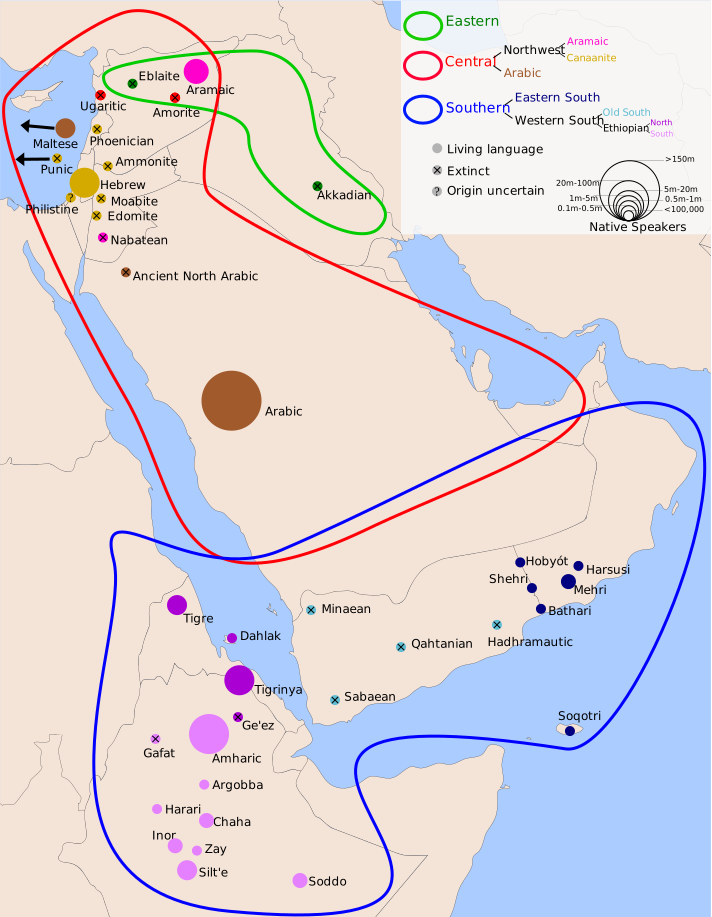
“Distribution of the Semitic Languages.” Semitic Languages. [Internet]. Available at: https://upload.wikimedia.org/wikipedia/commons/8/8f/Semitic_languages.svg [Accessed: 2024-07-07].
ECHR. European Court of Human Rights Court Européenne des Drots de l’Homme. Case of Refah Partisi (The Welfare Party) and Others vs. Turkey. [Internet]. Strasbourg: ECHR, 2003. Available from: https://hudoc.echr.coe.int/eng#{%22itemid%22:[%22001-60936%22]} [Accessed: 2024-07-07].
Encyclopædia Britannica. “Islamic World.” [Internet]. Britannica. Available from: https://www.britannica.com/topic/Islamic-world [Accessed: 2024-07-07].
Esposito, John. Islam: The Straight Path. Oxford: Oxford University Press, 2005.
Faruki, Kemal A. Islamic Jurisprudence. Karachi: Pakistan Publishing House, 1962.
Flannery, Kent V., and Joyce Marcus. The Creation of Inequality: How our Prehistoric Ancestors Set the Stage for Monarchy, Slavery, and Empire. Cambridge: Harvard University Press, 2012.
Freamon, Bernard K. “Slavery, Slave Trading, and the Law in the Pre-Islamic Middle East,” in Possessed by the Right Hand. The Problem of Slavery in Islamic Law and Muslim Cultures. Leiden: Brill, 2019. 20-87.
al-Ghazali, Abu Hamid Muhammad, and David B. Burrell, trans. Faith in Divine Unity and Trust in Divine Providence: The Revival of the Religious Sciences Book XXXV. (The Revival of the Religious Sciences, Book 35). Louisville: Fons Vitae, 2001.
Ġazālī, Muḥammad ibn Muḥammad Abū Ḥāmid, al. إِحْيَاه عُلوُم الدِّين Iḥyā’ ‘ulūm al-dīn. Cairo: al-Maktabat al-tiğāriyyat al-kubrá, [s.d.].
Ghāmidī, Jāved Aḥmad. البَيَان Al-Bayān. Lahore: al-Mavrid, 2015.
Gomez, Michael A. African Dominion: A New History of Empire in Early and Medieval West Africa. Princeton: Princeton University Press, 2008.
Gratien, Chris. “Race, Slavery, and Islamic Law in the Early Modern Atlantic: Ahmad Baba al-Timbukti’s Treatise on Enslavement”. North African Studies 18.3 (2013): 454-468.
Hallaq, Wael B. Sharī‘a. Theory and Practice. Transformations. Cambridge: Cambridge University Press, 2010.
Hair, P.E.H. “The Use of African Languages in Afro-European Contacts in Guinea: 1440-1560.” Sierra Leone Language Review 5 (1966): 5-26.
Hunwick, John O. “Aḥmad Bābā on Slavery”. Sudanic Africa 11 (2000): 131-139.
___, “Timbuktu: A Bibliography”. Sudanic Africa 12 (2001): 115-129.
“The Indian Ocean African Slave Trade 1500-1900.” [Internet]. Available from: https://s3.amazonaws.com/s3.timetoast.com/public/uploads/photo/12140660/image/b611ddbf1c7b81ad5802d98a53f9a5c4 [Accessed: 2024-07-07].
Inguaggiato, Giulia. “Il fenomeno dei bambini talibé e la tutela dei diritti dell’infanzia in Guinea-Bissau.” Manitese. [Internet]. November 9, 2020. Available from: https://www.manitese.it/il-fenomeno-dei-bambini-talibe-in-guinea-bissau/ [Accessed: 2024-07-07].
Juul Petersen, Marie. “Islam and Human Rights: Clash or Compatibility?” The London School of Economics LSE. [Internet]. June 11, 2018. Available from: https://blogs.lse.ac.uk/religionglobalsociety/2018/06/islam-and-human-rights-clash-or-compatibility/ [Accessed: 2024-07-07].
“Kingdom of Nabataea.” Alternate History. [Internet]. Available from: https://althistory.fandom.com/wiki/Kingdom_of_Nabataea_(Guardians) [Accessed: 2024-07-07].
Land of Ethiopians. [Internet]. Available from: https://s3.amazonaws.com/launchgood/project%2F1587%2Fbilal-al-habashi-595x370.jpg [Accessed: 2024-07-07].
Levi, Joseph Abraham. “Identity Matters: Culture and Religion as Key Factors in the Migration of Muslims.” Migration and Diversity 3.1 (February 2024): 29-50.
___, “Sharī’a Law and LGBTQIA+ People: More than Faith vs. Human Rights,” in Social Activism – New Challenges in a (Dis)connected World. Eds. Sandro Serpa, and Diann Cameron Kelly. London: IntechOpen, 2023a. 45-72.
___, “Jesuit Presence in Safavid Persia (1501-1736) and at the Court of جَلال الدِّین اکْبَر Jalāl al-Dīn, Akbar, the Great (r. 1556-1605): (Failed) Dialogs and Conversions Centered on Knowledge." International Journal of Arts and Social Science 6 10 (October 2023b): 119-151.
___, “Inferno, Canto XXVIII: 30-31. The Prophet Muhammad and the Caliph ‘Alī: (Mis)Representing the Body.” International Journal of Arts and Social Science 5 6 (June 2022): 98-132.
___, “Reconstructing the Abrogated. Exegesis of Qur’ān 53: 21-22.” International Journal of Arts and Social Science 4 2 (March-April 2021): 6-23.
___. Middle East History. Boca Raton: BarCharts, 2011.
Lewis, Bernard. Race and Slavery in the Middle East. Oxford: Oxford University Press, 1994.
Luttrell, Anthony. “Slavery and Slaving in the Portuguese Atlantic,” in The Transatlantic Slave Trade from West Africa: [Papers and Discussion Reports Contributed to a Seminar Held June 4th-5th 1965]. 1965. Edinburgh: Centre for African Studies, University of Edinburgh. 61-79.
al-Massufi, Aḥmad Bābā. مِعرَاج الصّعود الى نيل مجلوب السُّودَان The Ladder of Ascent in Obtaining the Procurements of the Sudan: Aḥmad Bābā Answers a Moroccan’s Questions about Slavery. 1615. [Internet]. Available from: https://upload.wikimedia.org/wikipedia/commons/9/9b/The_Ladder_of_Ascent_in_Obtaining_the_Procurements_of_the_Sudan-_Ahmad_Baba_Answers_a_Moroccan%E2%80%99s_Questions_about_Slavery_WDL9661.pdf [Accessed: 2024-07-07].
Mauny, Raymond. Tableau géographique de l'Ouest africain au Moyen Âge: d'après les sources écrites, la tradition et l'archéologie. N.º 61. 1961. Amsterdam: Swetz & Zeitlinger N.V., 1967.
Meir, David. “The Silence about Black Slavery in the Arab World”. The Times of Israel [Internet]. June 16, 2019. Available from: https://blogs.timesofisrael.com/the-silence-about-black-slavery-in-the-arab-world/ [Accessed: 2024-07-07].
al-Mufrad, Al-Adab 181. [Internet]. Available from: https://sunnah.com/adab:181 [Accessed: 2024-07-07].
al-Adab al-Mufrad, Al-Adab. 188, Sahih al-Albani. [Internet]. Available from: https://sunnah.com/adab:188 [Accessed: 2024-07-07].
al-Mufrad, Al-Adab 192. [Internet]. Available from: https://sunnah.com/adab:192 [Accessed: 2024-07-07].
Nor, Aishah Mohd, Zuraini Ab Hamid, and Lokman Effendi Ramli. “Human Trafficking from the Islamic Perspective”. International Journal of Religion 5.7 (2024): 501-514.
Powell, Emilia Justyna. Islamic Law and International Law. Peaceful Resolution of Disputes. Oxford: Oxford University Press, 2020.
Prasad, Kiran Kamat, and Jean-Pierre Angenot, eds. TADIA, the African Diaspora in Asia: Explorations on a Lesser Known Fact. Bangalore: Jana Jagrati Prakashana, 2008.
Quran.com. [Internet]. Available at: https://quran.com [Accessed: 2024-07-07].
Robertazza, Victor Joseph. “A integração dos Africanos no Império Português no Espaço Índico dos Séculos XV e XVI: Costa Oriental Africana / Subcontinente Indiano. Uma Nova História para Contar.” M.A. Thesis in History, History of the Portuguese Discoveries and Overseas Expansion. Lisbon: Universidade de Lisboa, 2025.
Santillana, David. Istituzioni di Diritto Musulmano Malichita com riguardo anche al sistema sciafiita. 2 vols. Rome: Istituto Per l’Oriente, 1925-1938.
el-Sawi, Myada Omar. “Beyond the ‘Tiers’ of Human Trafficking Victims: Islamic Law’s Ability to Push the Muslim World to the Top of the United States Trafficking Tier Placements and into Compliance with International Law.” Georgia Journal of International & Comparative Law 39 2011: 391-417.
Schacht, Joseph. “Islamic Religious Law,” in The Legacy of Islam. Eds. Joseph Schacht, and C. E. Bosworth. 2nd ed. Oxford: Oxford University Press, 1979. 392-403.
Shamsuddin, Justice P.K. “Bridging the Gap between the Universal Human Declaration of Human Rights and Sharia Law: A Path towards Harmonization.” International Movement for a Just World. [Internet]. June 20, 2024. Available from: https://just-international.org/articles/bridging-the-gap-between-the-universal-declaration-of-human-rights-and-sharia-law-a-path-towards-harmonization/. [Accessed: 2024-07-07].
Sharawi, Helmi. “The African in Arab Culture: Dynamics of Inclusion and Exclusion”, in Imagining the Arab Other. How Arabs and Non-Arabs View Each Other. Ed. Tahar Labib. New York: I. B. Tauris, 2008. 92-156.
Sharif, Surkheel (Abu Aaliyah). “The Truth about Taqlid (Part I).” The Jawziyyah Institute 2007. [Internet]. Available from: https://web.archive.org/web/20090306022617/http://web.mac.com/jawziyyah/The_Jawziyyah_Institute/Home_files/Taqlid%201.pdf [Accessed: 2024/07/07].
“Slavery in the Early Caliphate – Medieval History Documentary.” Kings and Generals [Internet]. August 25, 2022. Available from: https://youtu.be/5kDPPmZvSKY [Accessed: 2024-07-07].
“Slavery – Summary on a Map”. Geo History [Internet]. October 19, 2022. Available from: https://youtu.be/40d0eDAQ3t0 [Accessed: 2024-07-07].
Smith, Wilfred Cantwell. Islam in Modern History. Princeton: Princeton University Press, 1957.
Sole Russo, Maria. “Clash between Sharia Law and Human Rights in Light of PACE Resolutions 2253.” In Ius Itinere Rivista Giuridica [Internet]. Available at: https://www.iusinitinere.it/clash-between-sharia-law-and-human-rights-in-light-of-pace-resolution-2253-23827#_ednref1 October 15, 2019. [Accessed: 2024-07-07].
Stockton, Richard. “Islam, from the Middle Ages to ISIS.” July 7, 2017. Ed. John Koroski. All that is Interesting [Internet]. February 27, 2024. Available from: https://allthatsinteresting.com/isis-slavery-in-islam [Accessed: 2024-07-07].
Sunan an-Nasa'i 4736. [Internet]. Available from: https://sunnah.com/nasai:4736 [Accessed: 2024-07-07].
“El sultanato de Adal Adel”. Hechos importantes que pasaron el año 1500 en Africa. Cuando.org.es [Internet]. Available from: https://cuando.org.es/que-paso/que-paso-en-africa-en-el-1500.php [Accessed: 2024/07/07.
Taylor, Mildred Europa. “Ahmed Baba of Timbuktu, the Greatest African Scholar of the 16th Century You Should Know”. Face2face Africa November 29 2019. [Internet]. November 29 2019. Available from: https://face2faceafrica.com/article/ahmed-baba-of-timbuktu-the-greatest-african-scholar-of-the-16th-century-you-should-know [Accessed: 2024-07-07].
Tooba, Syed Abu, ed. Aqueedah of Ahle Sunnat wal Jamaat. All About Aqueedah in Islam. (With Sahaba Sxholars of Sunnah & Salafus Salehin Position in Aqueedah). [Internet]. Centre for Promotion of Islamic Dawah, Education, Peace, and Human Values. Available from: https://ia803202.us.archive.org/27/items/AllAboutAqeedahInIslamahleSunnatWalJamaatAqeedah/AllAboutAqeedahInIslam.pdf [Accessed: 2024/07/07].
Traini, Renato. Vocabolario Arabo-Italiano. 3 vols. Rome: Istituto Per l’Oriente, 1966-1973.
University of Minnesota. “Cairo Declaration on Human Rights in Islam, Aug. 5, 1990, U.N. GAOR, World Conf. on Hum. Rits., 4th Sessl, Agenda Item 5, U.N. Doc. A/CONF.157/PC/62/Add.18 (1993) [English translation].” University of Minnesota Human Rights Library. [Internet]. 1993. Available from: hrlibrary.umn.edu/instree/cairodeclaration.html [Accessed: 2024/07/07].
Veinstein, Gilles. “The Ottoman Jews: Between Distorted Realities and Legal Fictions”. Mediterranean Historical Review 25.1 (2010): 53-65.
VOA. “Guiné-Bissau: União Europeia apoia proteção de crianças Talibé.” VOA Voice of America. [Internet]. July 10, 2024. Available from: https://www.voaportugues.com/a/guin%C3%A9-bissau-uni%C3%A3o-europeia-apoia-prote%C3%A7%C3%A3o-de-crian%C3%A7as-talib%C3%A9/7692426.html [Accessed: 2024/07/07].
Watt, William Montgomery. Muhammad: Prophet and Statesman. Oxford: Oxford University Press, 1974.
Willis, John Ralph, ed. Slaves and Slavery in Muslim Africa. Vol. 1. Islam and the Ideology of Enslavement. London: Routledge, Taylor & Francis, 2015.
Zahra, Abū. أُصُول الفِقْه Uṣūl al-fiqh. Cairo: Dār al-Fikr al-‘Arabī, 1958.
Zurqānī, Muḥammad ibn ‘Abd al-Bāqī, and ‘Atīyat Allāh ibn ‘Atīyah Ujhūrī.حاشية عطية الاجهوري على شرح محمد الزرقاني على المنظومة المسماه بالبيقونية في مصطلح الحديث Ḥāshīyat ‘Aṭīyah al-Ujhūrī ‘alá Sharḥ Muḥammad al-Zurqānī ‘alá al-manẓūmah al-musammāh bi-al-Bayqūnīyah fī muṣṭalaḥ al-ḥadīth. 8 vols. Cairo: [n. pl.], 1888.
Downloads
Published
Issue
Section
License
Copyright (c) 2025 Joseph Abraham Levi (Author)

This work is licensed under a Creative Commons Attribution-ShareAlike 4.0 International License.